
English ![]()

Tel:
+86-18503201597
E-mail:
E-mail:
ADD:1007,Hanke Building, No. 44 Jianshe North Street
Views: 0 Author: Site Editor Publish Time: 2025-08-27 Origin: Site
Ready to welcome a scaly roommate? Reptiles are wonderfully low-maintenance compared with furry pets, take up less space, and they won't trigger most people's hair/feather allergies. Before you bring yours home, though, you'll want a secure terrarium with the right heating, lighting, décor, and substrate so your animal feels safe and thrives from day one. Below is your original step flow—rewritten for a smoother read—and expanded with practical, species-specific tips, safety notes, and a quick FAQ.
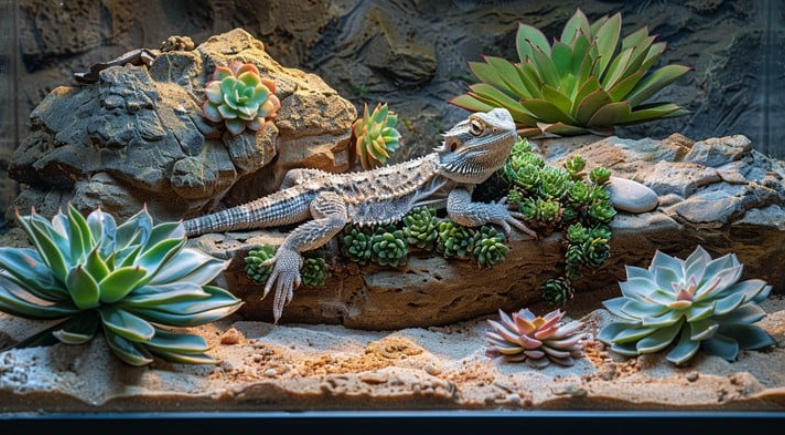
There isn't a single "best" size because species differ: climbers want height; ground roamers want floor space. As a rule, more room allows natural behavior and easier temperature gradients. That said, very young animals can feel exposed in huge spaces, so you can start modestly and scale up.
Starter size cheat sheet (minimums for a single animal):
•Leopard gecko (ground, shy burrower): 30″×12″×12″ (≈ 20-gallon long) or larger; more floor space is better.
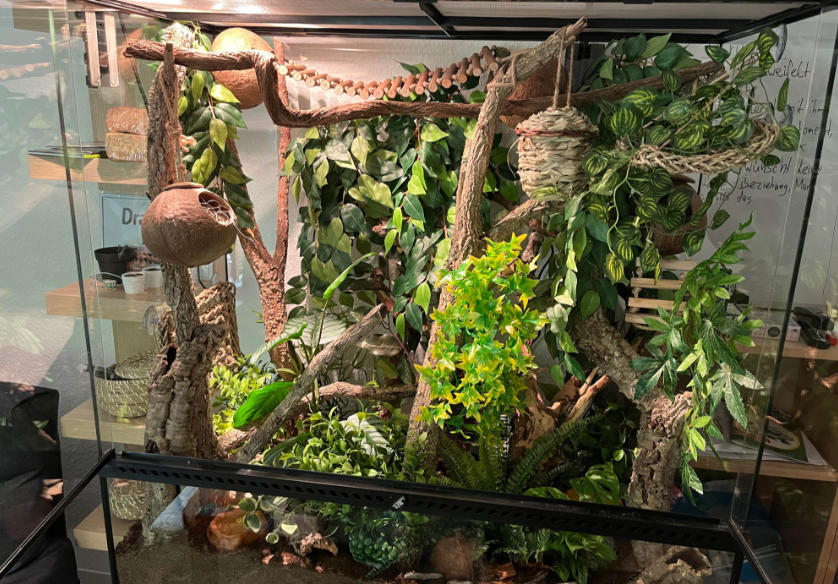
•Crested gecko (arboreal): 18″×18″×24″ vertical minimum; add branches and plants for height use.
•Corn snake (active, semi-fossorial): 36″×18″×18″ (≈ 40-gallon breeder) minimum; adults do great in 4′×2′×2′.
•Ball python (heavy-bodied, secretive): 4′×2′×2′ with snug hides; juveniles can start smaller if well-furnished.
•Bearded dragon (diurnal basker): 4′×2′×2′ for adults; juveniles can start in a 36″×18″×18″ with plenty of décor.
Tip: Match shape to lifestyle—tall for climbers, long for ground roamers. Ensure the lid/doors lock securely.
Reptiles are ectotherms—think "solar powered." Your job is to provide a warm side and a cool side so the animal can self-regulate.
Overhead sources mimic the sun and encourage natural basking.
•Halogen basking bulbs: bright, clean heat for day use (great for bearded dragons, skinks, diurnal snakes).
•Ceramic heat emitters (CHE) or Deep Heat Projectors (DHP): heat without light—useful for night-time warmth if the room runs cold (avoid colored "night" bulbs; continuous colored light can stress reptiles).
Safety must-dos:
• Always run every heat source on a thermostat.
• Use bulb guards/mesh covers so animals can't touch hot elements (snakes will wrap bulbs!).
• Keep fixtures away from flammables; check cords weekly; use surge-protected, grounded outlets (GFCI where possible).
• Never use "hot rocks/heat rocks." They create dangerous hot spots and commonly cause burns.
Under-tank mats warm the floor—useful for species that digest best with abdomen-to-surface heat (e.g., leopard geckos, hognose snakes).
•Mount mats externally under one side of the terrarium.
•Always pair with a thermostat + probe placed directly over the heated zone on the inside floor surface.
Targets vary by species. Examples (bask spot / cool side):
•Bearded dragon: ~100–105 °F (38–41 °C) bask / ~75–85 °F (24–29 °C) cool.
•Leopard gecko: ~88–92 °F (31–33 °C) warm floor / ~72–78 °F (22–26 °C) cool.
•Ball python: ~88–92 °F (31–33 °C) warm hide / ~75–80 °F (24–27 °C) cool.
•Crested gecko: ~74–78 °F (23–26 °C) day with a cooler retreat; avoid prolonged >82 °F (28 °C).
Tip: A gradient of ~5–8 °F (3–4 °C) across the terrarium is a good starting point—tune based on species and your animal's behavior.
Use a thermostat to control heat output and prevent overheating on warm days. Add two digital thermometers with probes—one on the warm side near the basking spot/warm hide, and one on the cool side. Round it out with a hygrometer to track humidity (see substrate/decor notes below for species targets).
All reptiles benefit from a stable day/night cycle (e.g., ~12 h day / 12 h night, seasonally adjustable). Many also need UVB to synthesize vitamin D and use calcium properly.
UVB needs vary by species (quick guide):
•High UVB (strong baskers; "desert/opensun"): Bearded dragons, uromastyx → high-output T5 HO UVB tube spanning ~½–¾ of the terrarium length.
•Moderate UVB (forest edge/partial sun): Blue-tongued skinks, many diurnal snakes → standard T5 UVB at correct distance.
•Low UVB (crepuscular/nocturnal – still beneficial but gentler): Leopard geckos, ball pythons, corn snakes → low-output UVB or provide a high-quality bright day-light spectrum and excellent diet + supplements if UVB is omitted.
•Crested geckos: low UVB is optional but often improves activity and appetite.
Setup tips:
• Use UVB tubes (T5 HO recommended) with a good reflector; position at the manufacturer's suggested distance.
• Mesh lids reduce UVB—mount the lamp inside when possible or adjust distance/output accordingly.
• Replace UVB bulbs per manufacturer life (often 6–12 months of effective output).
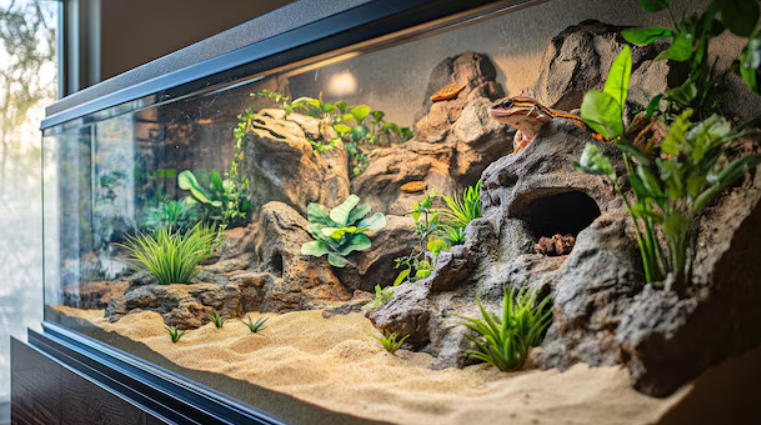
Aim to recreate function and feel of the natural habitat, not just the look.
•Hides: Place at least two—one on the warm side, one on the cool side. Tight, dark hides reduce stress.
•Climbing structure: Branches, cork rounds, rock ledges for climbers and semi-arboreal species.
•Basking platforms: Stable rocks/ledges directly under the basking bulb (ensure they can't shift).
•Humidity helpers: For species needing humidity, add a moist hide (sealed hide with damp sphagnum) and larger water dish surface area.
•Planting:
Arid setups (bearded dragon, uromastyx): sturdy faux plants, rock shelves, textured backgrounds; keep décor easy to sanitize.
Tropical/temperate species (crested, some snakes): cork flats, vines, safe live plants if you go bioactive (verify plant safety for the species).
Tip: Secure all décor. If you can wiggle it, a curious reptile or heavy snake can topple it.
Substrate affects grip, humidity, and burrowing. Pick for species + humidity and be mindful of ingestion risk.
By common species:
•Leopard gecko (dry/medium humidity): ceramic/stone tile, paper towel, or packed soil-based mixes; avoid loose dry sand for beginners due to impaction risk.
•Crested gecko (higher humidity): coconut fiber (coir), soil-based mixes with leaf litter; add a drainage layer in tall terrariums.
•Corn snake (moderate humidity): aspen shavings, shredded paper, or bioactive soil mix; provide 3–4″ (7–10 cm) for burrowing.
•Ball python (moderate humidity): cypress mulch, coco husk, or bioactive soil; spot-clean often to prevent humidity spikes.
•Bearded dragon (arid): for most keepers, solid substrates (tile, textured PVC liner, paper) are simplest and safe. Advanced keepers may use well-compacted soil/sand/clay mixes with strict spot-cleaning and correct moisture management.
Depth pointers:
•Burrowers love 4–6″ (10–15 cm) or more.
•Non-burrowers can do well on solid surfaces with dedicated dig boxes if enrichment is needed.
Always source reptile-safe substrate (clean, pest-free). Avoid aromatic softwoods (like untreated cedar) and anything dusty enough to irritate lungs/eyes.
Fresh, clean water should always be available. Replace frequently (warm tanks evaporate fast). For humidity-loving species, misting or an automated humidifier can help—but don't soak arid setups.
• Placing glass tanks in direct sunlight—greenhouse effect = dangerous overheating.
• Running heat without a thermostat.
• Using red/blue "night bulbs"—they disturb rest; use no light at night.
• Heat rocks or uncovered bulbs—burn hazards.
• One hide only—always provide warm-side and cool-side hides.
• Poor ventilation—stagnant air causes scale and respiratory issues.
• Mixing species or housing incompatible animals together.
• Feeding insects that are too large (general rule: no wider than the space between the reptile's eyes).
• Skipping quarantine for new arrivals.
Q: Do I need to mist every day?
A: Only if your species needs higher humidity (e.g., crested geckos). Track humidity with a hygrometer and mist as needed; avoid constantly wet conditions for arid reptiles.
Q: My reptile isn't eating—what now?
A: First, check temps and hides. Animals often refuse food when they're too cold or feel exposed. Confirm your warm-side and cool-side readings, offer appropriately sized prey, and minimize handling until feeding resumes.
Q: Do I need heat at night?
A: Many species do fine with a nighttime drop if your room doesn't get too cold. If supplemental night heat is needed, use a thermostat-controlled CHE/DHP (no light).
Q: How often do I clean?
A: Spot-clean daily; replace water daily. Do a deeper clean as needed (weekly to monthly) based on substrate and species. Bioactive terrariums still need spot-cleaning and periodic refreshes.
Q: Which UVB should I buy?
A: Match the lamp's output and distance to your species' needs (high, moderate, or low UVB as above). Prefer T5 HO tubes with reflectors; replace per manufacturer schedule.
Your setup is now truly "leveled up"—dialed-in heat gradient, species-matched UVB/day–night cycle, functional décor, and a substrate plan that keeps things clean and healthy. If you're using a Bingyu terrarium, you'll also benefit from our cross-vent layouts, cable ports, stackable frames, and UVB-ready mounting space that make fine-tuning much easier. Need something specific? We can OEM/ODM custom sizes, sliding or hinged doors, added ventilation, and accessory bundles (thermostat, basking lamp, UVB tube) pre-matched for common species like leopard geckos, crested geckos, ball pythons, corn snakes, and bearded dragons.


